
Frequently Asked Questions
Answer: Residents and families are encouraged to personalize their room with pictures, plants, mementos, and other items to make for a homey atmosphere. A favorite chair should be of a vinyl or leather type material. We discourage residents from keeping valuable items, such as expensive jewelry and large sums of money, in their rooms. The facility cannot take responsibility for such items. Some residents with varying degrees of dementia may not recognize the value of an item and may unintentionally discard or misplace it.
Yes! We can even help you apply for Medicaid. We also take Medicare A, many insurances and private pay.
Yes! Our staff can give you and your family a tour of our facility at anytime. Making a decision to move a loved one into a facility is difficult, but seeing our great nurses at work can help reassure you.
Answer: Pay your bill online quickly by clicking the Online Payment menu option at the top of our site.
Two options are available to you:
- One Time Payments
- Recurring payments.
We accept most credit/debit cards along with bank transfers.
In order to pay your bill you will need to know:
- The name of the facility
- The resident’s name
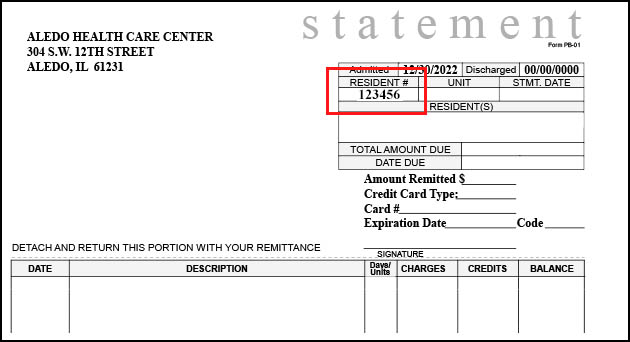
- The resident’s ID number, which is located on your billing statement.
If you do not know your resident’s ID number, you can reach out to the facility and they will be able to provide it for you.
The resident ID is located on the billing statement here:
We are still accommodating virtual visits and can assist you in connecting with your loved one via phone, Facebook Live, Zoom, Skype, FaceTime, and other virtual or social media platforms.
Answer: Nursing homes are designed to care for individuals who are unable to care for themselves and have numerous healthcare requirements. Assisted living facilities are designed to help persons who are able to care for themselves except for a few everyday activities. Their goal is to create an environment for each resident to maintain his or her independence for as long as possible. They offer help with activities of daily living (ADLs), such as: preparing meals, bathing, taking medications, dressing and performing household chores. In addition, our assisted living facilities may also be appropriate for those who may be experiencing some memory problems which interfere with their ability to manage ADLs on a regular basis. Some facilities are even licensed to offer multiple levels of care, while others may only offer one level.
Answer: We recommend at least seven complete outfits. Appropriate clothing is usually considered to be slacks, shirts or tops, dresses, sweatsuits, sweater, nightgown/sleepwear, and underwear. Shoes or slippers should have nonslip soles. As a general rule, clothing should be roomy and have large enough openings that they can be put on and removed with a minimum of stress to both the resident and the clothing. 1. Personal laundry service is provided by the facility. 2. Clothing should be machine washable and dryable. 3. Each item of clothing should be indelibly marked with the resident’s name (first initial and last name). 4. Families should expect to assist in maintaining the resident’s wardrobe.
Answer: Please be sure to include the resident’s first and last name when sending mail to our facility. All personal mail is delivered unopened to each resident. Upon resident or family request, helpful staff or volunteers can assist with opening and reading mail.
Yes! We offer respite care for short-term residents. Every respite resident receives the same great 24-hour care and amenities that our long-term residents receive. Contact us today to learn more about how we can help.
Answer: Making the decision as to how much care is needed can be difficult. That’s why seeking a physician’s assistance, along with counseling by qualified professionals, is appropriate. At Petersen Health Care, we have experienced staff available to help make an assessment and discuss your options with you and your family. By doing so, we can help you determine the best facility for your situation and care level. In addition, our staff is able to help you with any necessary paperwork and financial information.
Admitting a loved one can be extremely overwhelming to family members.We take the time to talk to you and simplify the process. Whether it is respite care, short-term Rehab-to-Home therapy, long-term care, specialized Alzheimer’s care or any one of our many other options. We are here to help care for your loved one.
We have a great activity departments that try to find something for everyone. Whether it is Bingo, a Wii bowling tournament or just reminiscing, there are plenty of activities for everyone to do.
Answer: Medicare is federal health insurance for every American 65 years of age or older. It covers acute episodes, such as hospitalization and rehabilitation after leaving a hospital. Like all insurance policies, it does not cover all the expenditures. That’s why many will purchase supplemental or “Medigap” insurance to cover copayments and deductibles. In addition, this supplemental insurance can be used to pay for non-covered expenditures such as prescriptions. In general, Medicare does NOT pay for long-term care – either in nursing homes or in an assisted living community. For more information on Medicare, please visit the Medicare website at http://www.cms.hhs.gov/medicare. Additional information on Medicare and Medigap is also available from SHIIP. Medicaid is a state-managed healthcare and long-term care program for the financially needy. Typically, those with low income and very few assets are eligible for Medicaid. In most states, Medicaid will pay for nursing home care and some have the option of remaining in their homes and receiving in-home services. For more information, please visit the Medicaid website at http://www.cms.hhs.gov/medicaid
Answer: Intermediate Care is appropriate for persons who may need some nursing intervention, but not on a continuous basis. Rehabilitation programs, activities and personal care assistance are available, and the care is provided under the direction of a physician.
Answer: Skilled Nursing Care is appropriate when the patient needs ongoing nursing intervention and supervision following an illness or a chronic condition. It is also appropriate for short-term intensive physical, occupational or speech rehabilitation therapy. The patient’s care is under the direction of a physician.
We understand that due to these restrictions communication has been limited, but we have introduced other ways that you can interact with your loved ones, and still keep them safe. These communication tools include:
- Skype
- FaceTime
- Writing Letters
- Facebook Messenger
- Facebook Video Chat
- Facebook Video Messages
We’re here to help with any of these tools to keep you in touch with your loved ones. If you’re not already, follow us on Facebook for updates on the activities we’re doing daily to keep our residents active and busy during this “Shelter in Place” initiative.